

The short answer
Roofing companies win metal roof jobs by selling the roof as a long-term investment, not as a like-for-like replacement. The winning pitch is simple: a metal roof lasts decades longer than asphalt, reflects heat and can cut cooling costs, and stands up to wind, hail and fire better than shingles. Winners teach the standing-seam versus screw-down difference, show the cost per year, put the warranty in writing, and follow up fast. Metal is the premium ticket in roofing. You win it by making the value obvious, not by discounting it.
Introduction: metal is a different sale
An asphalt shingle job is often a distress purchase. A leak appears, a storm hits, and the homeowner wants a solid roof at a fair price as soon as possible. A metal roof is rarely bought that way. The homeowner who asks about metal is usually planning ahead, expects to stay in the house, and is tired of thinking about the roof. They are shopping for confidence, not the cheapest quote.
That changes the whole conversation. If you quote metal like shingles — one number, one page, no explanation — you will lose to the roofer who explained it. Two metal quotes are rarely for the same thing: one may be standing seam with hidden fasteners and a 40-year paint warranty, the other exposed-fastener panels with a shorter warranty and a lower price. Without that explanation, the homeowner picks the lower number and wonders later why the roof leaks at the screws.
What the numbers say
The numbers below are external research, not DigiXpot results:
- A metal roof can last 40 to 70 years, according to the Metal Roofing Alliance, compared with around 20 years for a typical asphalt shingle roof. That is one metal roof instead of two or three shingle roofs.
- Metal roofing is often made with recycled material and is fully recyclable at the end of its life, according to the Metal Roofing Alliance. A shingle tear-off mostly goes to landfill.
- Cool metal roofs reflect solar heat and can lower roof surface temperatures, according to the U.S. Department of Energy and ENERGY STAR guidance on cool roofs.
- 92% of consumers trust recommendations from people they know above every other form of advertising — Nielsen (2012), 28,000+ respondents in 56 countries; Nielsen (2013) put it at 84%.
- 97% of consumers read online reviews for local businesses, and 49% trust online reviews as much as a personal recommendation — BrightLocal 2026 (1,002 US adults).
- 85% of consumers are more likely to use a business after reading positive reviews — BrightLocal 2026 — and 74% only consider reviews from the last three months.
- Contacting a lead within 5 minutes makes a company 21 times more likely to qualify it than waiting 30 minutes — and 100 times more likely to reach the person at all — XANT Lead Response Management study (2007).
- Only about 38% of small-business calls are answered by a live person — 411 Locals study.
The lesson is plain: the product lasts decades, the buyer trusts people they know and reviews they can read, and the lead goes cold fast. Win by proving the roof will last, proving you can be trusted, and answering the phone.
1. Sell durability first, because that is what the homeowner is really buying
Start every metal roof conversation with durability — the reason the homeowner called you about metal. Nobody pays a premium for a roof that looks nice for five years. They pay a premium for a roof they will not have to replace again.
Say the lifespan out loud, in the first minute: a metal roof can last 40 to 70 years, according to the Metal Roofing Alliance, against around 20 years for asphalt shingles. Over 50 years, that is one metal roof against two or three shingle roofs, tear-offs and bills. Metal is not the expensive option over that span. It is the option that ends the cycle.
Durability is not only about years. It is about what the roof survives: metal stands up to high wind, hail and fire better than shingles, and sheds snow and rain fast. Talk about the homeowner’s actual weather. If their street lost shingles in the last big storm, say so. If their neighbour’s metal roof came through untouched, say that too.
Show the durability, do not just claim it. Carry a sample panel to every metal estimate and let the homeowner hold it. A metal roof lasts decades when installed properly, with the right underlayment, flashing and fasteners. The homeowner is not just buying metal. They are buying the crew that knows how to put it on.
2. Make the energy savings concrete, not a slogan
“Metal roofs save energy” is a slogan, and slogans do not move a five-figure decision. What moves it is a concrete explanation: a light-coloured, reflective metal roof bounces solar heat back into the sky instead of soaking it into the attic. The U.S. Department of Energy and ENERGY STAR describe the same effect for cool roofs — a reflective surface runs cooler, so less heat is pushed into the home.
In a hot climate, the air conditioner runs less in the afternoon, when the sun is hardest on the roof. In a milder climate, the saving is smaller — say so. A roofer who promises big energy savings in a cool climate loses trust. One who says the saving is real but modest, and durability is the bigger reason to buy, gains it.
Then make it personal. Ask what the upstairs feels like at four in the afternoon in July. Colour matters, too: a white or light-coloured roof reflects more heat than a dark one. If the homeowner loves a dark bronze roof, do not pretend it will perform like white. Tell them the trade-off honestly, and let them choose.
3. Teach standing-seam versus screw-down, and recommend honestly
This section wins or loses most metal jobs, because most roofers skip it. The homeowner has heard both terms and does not know the difference, and the two systems are not the same product at the same price. Without an explanation, they will compare your standing-seam quote against a competitor’s screw-down quote as if they were identical.
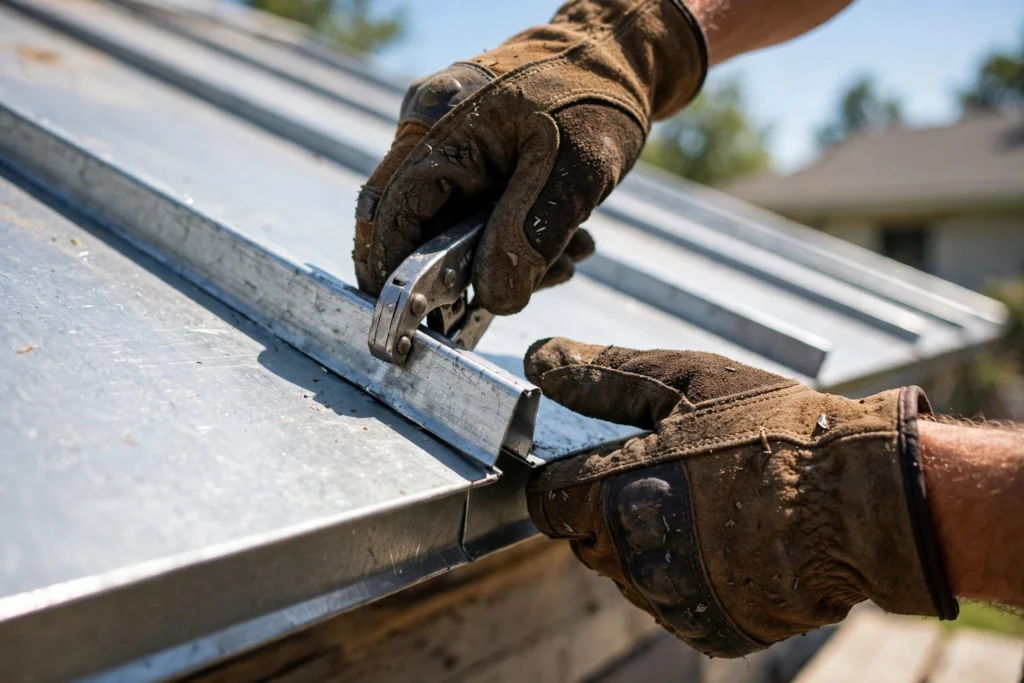
Standing seam is the premium system. Panels run vertically from ridge to eave, locking together with hidden fasteners, so no screws pierce the face of the roof and there is nowhere for water to enter through a fastener hole. It looks clean and modern, lasts the longest, and costs the most.
Screw-down, also called exposed-fastener, is the simpler system. Panels are screwed straight through the face of the metal into the deck, with a rubber washer under each screw head. It costs less upfront, goes on faster, and suits barns, sheds, garages and agricultural buildings. The trade-off is the screws: exposed to weather, the washers age, and the screws need checking and occasional replacement.
Your job is to recommend, not just to list. Ask where the roof is going, how long the owner plans to stay, and what the budget is. For a forever home, recommend standing seam and say why. For a barn or a rental on a tight budget, screw-down may be the honest answer. Put the system name on the estimate in plain words, with fastener type, gauge, coating and warranty beside it. A thinner panel dents more easily, and a cheaper coating fades sooner.
4. Price the premium ticket in plain numbers, per year
Metal costs more than shingles, and everybody in the room knows it. The mistake is to apologise for it, or to hide behind a single big number. The winning approach is the opposite: put the price in the open, break it down, and show the cost per year.
If a metal roof costs roughly twice a shingle roof but lasts two to three times as long, the cost per year is lower, not higher. Do that division in front of the homeowner, on paper, with their actual numbers — not a round number from a brochure. A roof is bought by the year, not by the day, and metal wins by the year.
Break the total down, too: material, labour, underlayment, flashing, tear-off and disposal, and warranty. A lump sum invites suspicion. A broken-down estimate invites trust, because the homeowner can see where the money goes. Offer good, better, best — three options at most: screw-down, standing seam in a standard colour, or standing seam in a premium coating. Label the differences, and let the homeowner decide with their eyes open.
Finally, do not discount the premium to win the job. A discount tells the homeowner the price was inflated. If the price needs to come down, change the scope — a simpler colour, a different panel — and show what changes. Hold the price, change the product, and keep the trust.
5. Put the warranty in writing before you ask for a signature
A metal roof is a 50-year promise, and a verbal promise is worth nothing. The warranty is where that promise becomes real. Most roofers mention it at the end, as an afterthought. The roofers who win metal jobs put it in the middle of the pitch, in writing, before they ask for a decision.
There are two warranties. The manufacturer warranty covers the metal itself — paint, coating, and often the panel against defects. The workmanship warranty covers your installation. A long manufacturer warranty with a one-year workmanship warranty is a warning sign, because most metal roof problems are installation problems, not material problems. Say that out loud, then show your workmanship warranty: the years, what it covers, and what would void it.
Get the warranty in the homeowner’s hands during the estimate, not after the deposit. A printed warranty sheet — manufacturer name, coverage, term, and your workmanship term beside it — turns an abstract promise into a document the homeowner can show their partner. Be honest about the limits: no warranty covers storm damage the way insurance does, and none covers a roof that was never maintained. A homeowner who hears the limits from you, before signing, trusts the coverage you do offer.
6. Follow up fast, and make financing easy
A metal roof is a big decision, and big decisions take time. That is also the excuse roofers use to wait a week before calling back. Do not wait a week: the homeowner who asked for a metal estimate has also asked someone else, or will do tomorrow. The roofer who calls back first, with answers, stays in the running.
The XANT Lead Response Management study from 2007 found that contacting a lead within 5 minutes makes a company 21 times more likely to qualify it than waiting 30 minutes, and 100 times more likely to reach the person at all. Speed is not pressure. Speed is service. Call the same day the estimate is requested, send it within 24 hours of the inspection, and call the next day to walk through it. Answer your own phone, too: only about 38% of small-business calls are answered by a live person, according to the 411 Locals study.
Financing is the other half of closing a premium job. A metal roof can be twice the price of shingles, and that price stops a homeowner who would otherwise say yes. Financing does not make the roof cheaper, but it makes the decision smaller: a monthly payment they can fit into a budget, instead of one large payment. Offer it on every metal estimate, early, and show the total and the monthly figure side by side.
Reviews close the loop. A metal roof is expensive, visible and long-lasting, so the homeowner will check your reviews before they sign. BrightLocal’s 2026 survey found 97% read online reviews, 85% are more likely to use a business after reading positive reviews, and 74% only consider reviews from the last three months. Ask every metal customer for a review when the job is done. A referral from a happy metal customer is worth more than any ad: 92% trust recommendations from people they know above every other form of advertising, according to Nielsen in 2012, with 84% in the 2013 survey. For more on turning happy customers into the next job, see How Roofing Companies Win Referral Jobs. For the follow-up rhythm that keeps high-value estimates from going cold, see how roofing companies get more leads.

The 6-step metal roof system
- Answer fast and book the inspection the same day.
- Inspect, measure and listen — check the roof and attic, then ask how long they plan to stay.
- Teach the choice in plain language — standing-seam versus screw-down, with a sample panel in your hand.
- Send a clear, broken-down estimate within 24 hours — total, cost per year, both warranties.
- Call the next day and walk through the estimate — answer questions, show the monthly figure, and ask for the decision.
- Install, inspect and ask for the review — finish clean, register the warranty, and ask for a referral.
Checklist: what to do this week
- ☐ Carry standing-seam and screw-down samples to every metal estimate.
- ☐ Put cost-per-year maths in your metal estimate template.
- ☐ Print a one-page warranty sheet: both terms, and what each covers.
- ☐ Add a financing line to every metal estimate: total and monthly, side by side.
- ☐ Set a same-day callback rule for metal leads, and a next-day call after every estimate.
- ☐ Photograph your last three metal roofs, and ask those customers for a review.
- ☐ Check your reviews: at least 20, recent, four stars or higher, and replied to.
- ☐ Put system, gauge, coating and warranty on every metal quote in plain words.
What to avoid
- Quoting metal like shingles. One number, one page, no explanation.
- Hiding which system the quote is for. If the estimate does not name the system, gauge and coating, the homeowner will assume the worst.
- Promising energy savings you cannot defend. A dark roof in a cool climate will not slash the cooling bill.
- Discounting the premium to win the job. A discount tells the homeowner the price was inflated. Change the scope instead.
- Mentioning the warranty only after the deposit. Put it in writing during the estimate, with both terms, before you ask for a signature.
- Waiting a week to follow up. A metal lead who waits a week has already had another roofer on the roof.
- Hiding the total behind the monthly payment. Show both figures side by side.
- Letting your reviews go stale. BrightLocal 2026 found 74% only consider reviews from the last three months.
Frequently Asked Questions
Win the premium job with a clear pitch
Metal roofing is the premium ticket in roofing, and the companies that win it are not the cheapest — they are the clearest. They explain the durability, make the energy story concrete, teach the standing-seam versus screw-down choice honestly, put the warranty in writing, and follow up before the lead goes cold. If your metal estimates are going out but the jobs are going to someone else, the fix is usually in the pitch, not the price. For how metal fits with the rest of your roofing marketing, see the Roofing Marketing pillar page.
Book a free audit and we will look at how your roofing company sells metal roofs, from the first call to the signed estimate.
